Past years · Daily read
The History of Online Poker: From IRC to Moneymaker
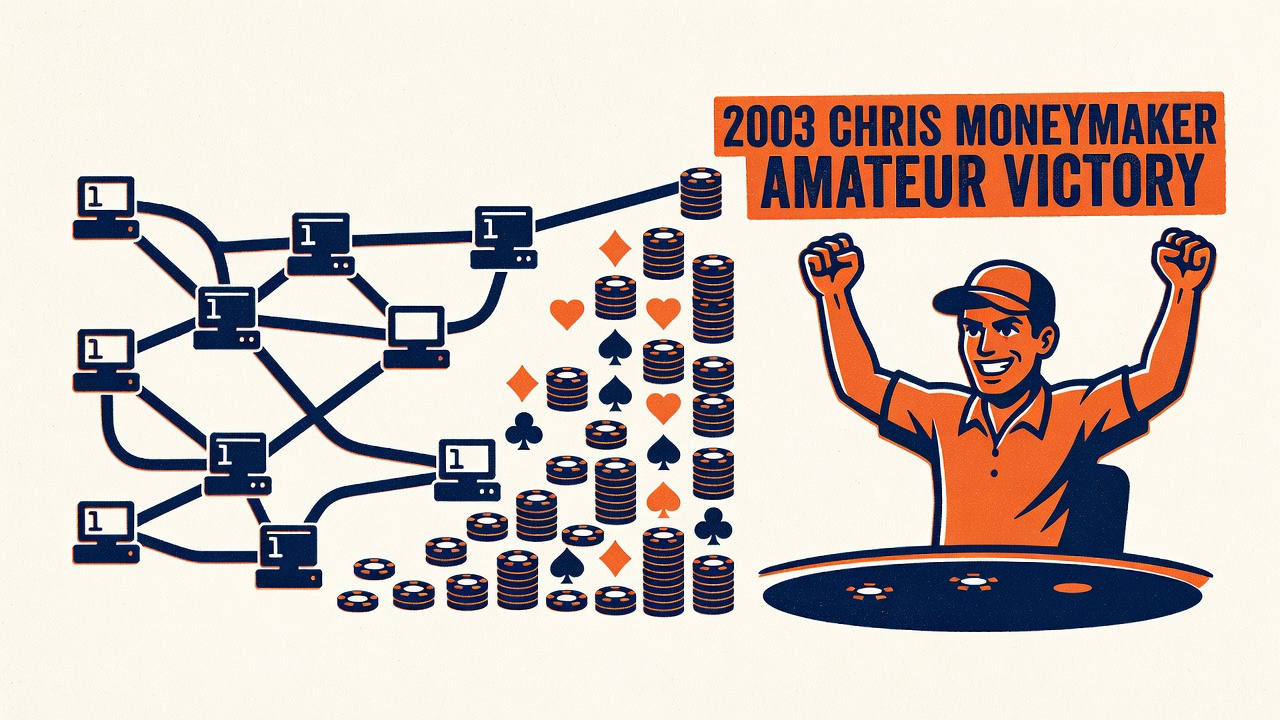
Online poker emerged from university computer networks and evolved into a global phenomenon. The 2003 World Series of Poker Main Event victory by Chris Moneymaker proved that amateurs could compete with professionals, fundamentally reshaping the game.
By Paula Nguyen, 4 min read
Day169
Entered under Past years. Also under Headlines, Deposits & cashouts, Poker and Table maths.
The history of online poker is the history of how a closed community of professionals was invaded by the public. It is also the history of how the public was subsequently disappointed by the realities of the game.
Poker existed in person for centuries. It was played in saloons, clubs, and casinos. The players were predominantly men with time and money. The skill barriers were high. You had to have capital to ante, experience to understand the mathematics, and emotional regulation to withstand losses. The game was thus exclusive by economic design.
Online poker emerged in the early 1990s on USENET and IRC channels. Young programmers, primarily American computer science students, began playing text-based poker. No money was involved initially. These were practice games played between colleagues across university networks. But in 1998, Planet Poker launched the first real-money online poker room. Players could deposit funds and play for actual stakes.
The significance of this innovation is that it eliminated the geographical barrier. A player in rural Wyoming could now compete against a player in Manhattan without traveling. The skill barrier remained, but the economic barrier to entry decreased. Suddenly, ordinary people with disposable income could play poker against good players without having to travel to Las Vegas.
Internet gambling expanded rapidly. By 2000, dozens of online poker sites existed. Party Poker, PokerStars, and Full Tilt Poker became dominant. The sites competed for players by offering bonuses and tournaments. Remarkably, the mathematical quality of play online was poor. Many early online players had never played live poker. They made fundamental mistakes that experienced players exploited. The sites were profitable for a simple reason: most players lost money, as expected.
The Moneymaker Moment
In May 2003, an accountant from Tennessee named Chris Moneymaker sat down at the World Series of Poker Main Event in Las Vegas. He had won his entry fee in an online poker tournament at PokerStars. Moneymaker had never played live poker professionally. His prior experience was home games with friends.
He won the tournament. He defeated 2,576 other players and won 2.5 million dollars. The final table was broadcast on ESPN. A nation watching television saw an ordinary person from an ordinary background beat professional gamblers.
The cultural impact cannot be overstated. Moneymaker's victory proved that online poker training could produce tournament winners. It proved that professionals did not have an unbreakable monopoly. It proved that an amateur with sound statistical understanding could compete at the highest level.
The following year, 8,773 players entered the Main Event. The year after, 10,000 entered. The poker boom was underway. Online poker sites saw their player bases explode. Tournament series proliferated. The money in the game increased by orders of magnitude.
What happened next was predictable in retrospect but surprising at the time. The quality of online players improved dramatically. The early poor players were replaced or educated. By 2008, online poker was producing more skilled players than existed in the entire history of live poker. The skill floor rose. Winning a tournament became genuinely difficult again.
The Structural Changes
Online poker transformed several aspects of the game. First, it democratized access. You no longer needed to be wealthy enough to travel to Las Vegas. Second, it accelerated skill development. Players could play thousands of hands per month instead of tens. Third, it created information transparency. Every hand was recorded and analysable. Players began using software to track their own play and their opponents' patterns.
The rise of poker strategy discussion forums and training sites occurred in parallel with online poker's growth. Players would discuss hands online, analyse positions, and develop GTO (game theory optimal) strategies. This collective knowledge creation was unique to the internet age. In the pre-internet era, poker strategies were kept secret or shared only within trusted circles. Online, all knowledge was public.
But the Moneymaker Moment also created a problem. Millions of new players, inspired by his victory, began playing online poker expecting to make money. Most lost money instead. The democratisation of access created democratisation of losses. For every Chris Moneymaker, there were thousands of players who lost their bankrolls.
What Changed Afterwards
In 2006, the United States Congress passed the Unlawful Internet Gambling Enforcement Act. This law required banks to block transactions to online gambling sites. Overnight, American players lost access to most online poker rooms. PokerStars and Full Tilt Poker were shut down. The American market, which had been the growth engine for online poker, became inaccessible.
Other jurisdictions filled the gap. European-licensed poker sites continued operating. Players from the United Kingdom, Germany, and other countries where online poker was legal continued playing. The poker boom continued globally, but the American dominance in the market ended.
In retrospect, the history of online poker is the history of a skill game becoming public. The game itself did not change. The rules were the same. The odds were the same. But the players became more numerous and more skilled. The easy wins for professionals disappeared. The struggle for amateurs increased.
Chris Moneymaker inspired millions of people to try online poker. A few became professional players. Most lost money. This is a common pattern in gambling history: a visible success leads to widespread participation, which leads to the equilibration of skill, which leads to most new entrants losing their investment.
Twenty years later, the poker world is more professionalized and less accessible than it was in 2003. Winning at online poker requires genuine skill now, not just relative advantage over worse players. The structural opportunity that Moneymaker exploited no longer exists.
End of the entry for Day 169