Bonus offers · Daily read
Sports Betting Welcome Offers vs Casino Welcome Bonuses
The difference between a sports betting bonus and a casino bonus is not a difference in money. It is a difference in what you are actually purchasing when you accept it.
By Paula Nguyen, 3 min read
Day115
Entered under Bonus offers. Also under Deposits & cashouts, Licences & law, Our tests and Sports bets.
Bonuses claiming to be free remain falsely promoted. Bonuses delivering tangible utility remain accurately stated. These propositions coexist without contradiction once you grasp what genuine acquisition occurs.
When DraftKings tenders $100 in bonus allocations, receipt of $100 does not transpire. You obtain licensing to wager $100 under prescribed conditions, necessitating replay of such amount multiple instances prior to extraction. The expense tied to this licensing represents your prospective expected depletion. Inquiry does not address bonus generosity. Question centers on whether conditions exceed acceptable alternatives.
The Structural Difference
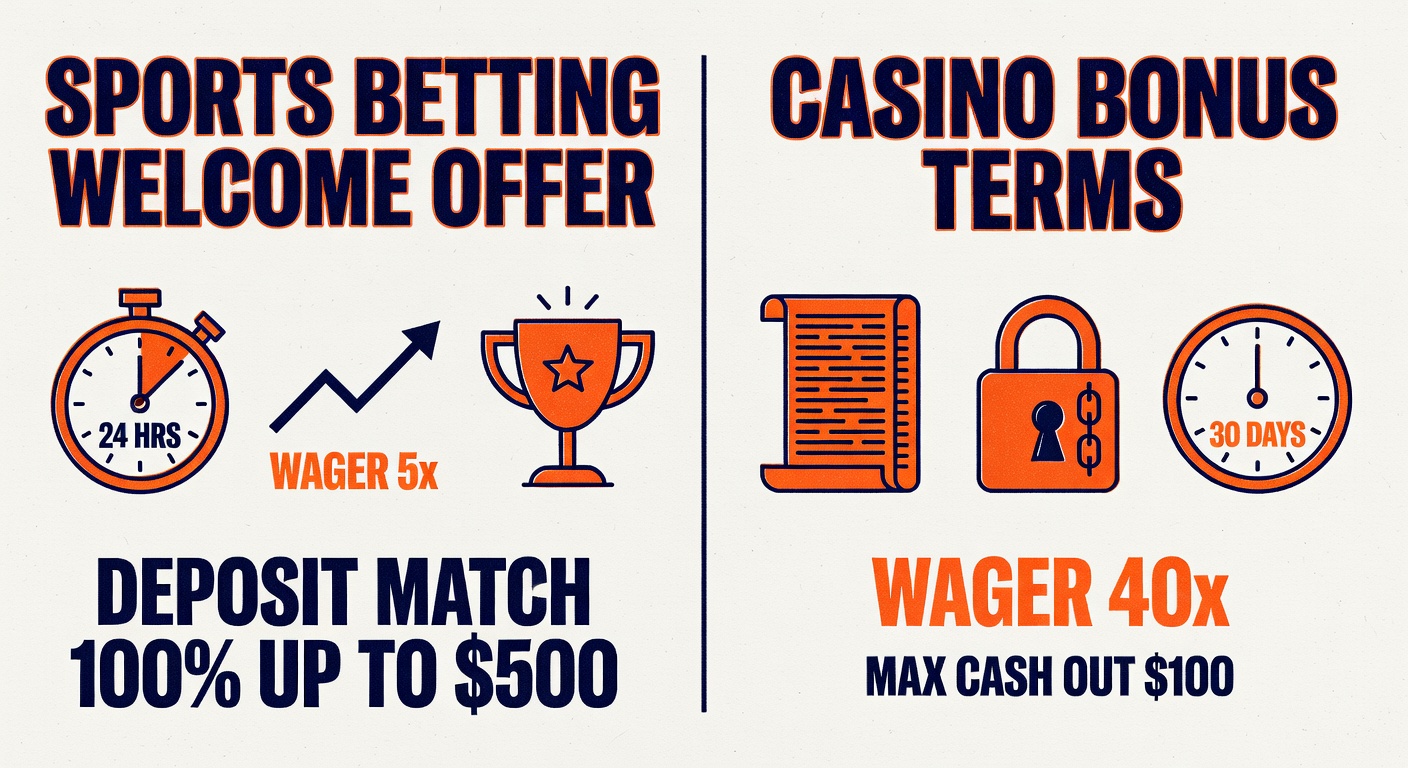
Sports betting bonuses demand completion: wagering summing to N multiples of the allocation spanning Y duration. Casino bonuses demand comparable fulfillment, yet execution accelerates. Sports participants encounter waiting;contests must conclude. Gaming patrons execute and resolve 50 wagering actions hourly.
Temporal discount rates diverge across products. Sports bettors price allocations lower since accumulation requires extended horizons. Gaming participants price allocations higher since acceleration diminishes temporal commitment. Holding mathematical advantages identical, gaming allocations possess superior objective valuation.
Bet365 illustrates: casino deposit allocation reaches 100% extending to 100 pounds, requiring 20x repetition. Sports allocation provides 100 pounds complimentary, demanding 30x repetition. Initially, casino arrangement appears superior (20x versus 30x). Actually, gaming allocation demonstrates greater substantive worth because completion occurs within afternoon timeframes. Sports allocation potentially consumes weeks.
The Subjective Value Component
Economists from Austrian traditions observe heterogeneous participants maintaining divergent temporal inclinations and volatility tolerances. Participants preferring instantaneous feedback alongside elevated variance prize gaming allocations beyond equivalent sports allocations. Participants favoring methodical grinding alongside considered examination prize sports allocations proportionally.
Formulas cannot quantify valuation heterogeneity. Allocation valuations diverge across participant populations. Determination hinges on discount factors, volatility aversion, and opportunity expenditures.
Consider participants allocating sixty minutes weekly gambling. 30x sports allocations become impossible. Equivalent 20x gaming allocations prove manageable. Mathematical advantages remain identical. Subjective valuations diverge completely.
The House Edge Constraint
Both allocations face economic constraint: gambling establishments cannot provide value surpassing mathematical advantage longevity. Gaming advantages reaching 2%, combined with 20x repetition, enable operators retaining 40% (20x times 2% equaling 0.4x). 1x allocation costs operators 0.6x expense. Participants receive 1x, operators forfeit 0.6x. Participant net advantage reaches 0.4x, representing 40% allocation recovery.
Sports allocations function within corresponding economics. Sports advantages averaging 4.5% (standard vig), combined with 30x repetition, enable operators retaining 1.35x (30x times 4.5% equaling 1.35x). Allocation costing 1x generates -0.35x? Negative? Loss?
Incorrect. Operators don't uniformly provide 4.5% to all bettors. Sophisticated participants outperform averages. Recreational participants underperform. Operators tender allocations expecting aggregate equilibrium, acknowledging sophisticated participants potentially surpass offers while recreational participants exhaust allocations quicker.
Gaming allocations differ. Operators understand blackjack advantages, roulette advantages, slot advantages. Advantages are transparent. Operators calculate with certainty: 20x repetition at 2% advantage advantages operator profitability. Sports operators calculate with ambiguity, since advantage fluctuates by bet category and bettor sophistication.
The Discount Rate Implication
Imagine receiving $100 immediately or $150 seven days later. Valuation depends on your temporal discount. High temporal discount (valuing immediate wealth far exceeding future wealth) renders $100 currently more precious. Low temporal discount renders $150 superior.
Sports allocations feature extended temporal windows. Reduced valuation transpires among participants with elevated temporal discounting. Gaming allocations feature compressed windows. Increased valuation transpires identically.
Explaining identical participants accepting gaming alternatives refusing sports alternatives: identical monetary quantities, divergent valuations. Operators comprehend. They calibrate compensation accordingly. Sophisticated participants should likewise.
The Regulatory Component
Gaming allocations receive complete statutory oversight. Repetition necessities require disclosure. Qualifying games necessitate enumeration. Extraction conditions remain fixed. Participants calculate precise reception quantities.
Sports allocations face reduced statutory oversight (jurisdictionally dependent). Certain operators withhold odds information requiring bonus wagering. Restrictions apply targeting eligible sports or qualifying bet categories. Information disparity advantages operators. Participants accepting sports allocations acquire undisclosed conditions exchanging speed.
Gaming participants quantify allocation authenticity. Sports participants frequently cannot. Not malice;product architecture. Gaming constitutes discrete, resolved construction. Sports constitutes fluctuating, continuous construction.
The Purchasing Decision
Allocation assessment does not assess free capital. Assessment quantifies option expense: favorable gambling condition procurement. Question addresses allocation inherent value. Question addresses condition superiority absent allocation, whether option warrants temporal and financial commitment.
Gaming allocations requiring four hours and $5,000 aggregate wagering for $100 allocation access yield approximately $2.50 hourly compensation, assuming 2% advantage. Sports allocations requiring fourteen days yield proportionally decreased hourly compensation despite nominally equivalent mathematics.
Austrian frameworks establish subjective valuation. Allocations lack uniform worth across participant populations. Offer construction (gaming versus sports, repetition magnitude, temporal windows) determines valuation alignment with specific participants' temporal inclinations and opportunity expenditures.
Operators understand. Operators establish terms accordingly. Sophisticated participants should think identically.
End of the entry for Day 115