Bonus offers · Daily read
How Online Casino Deposits Work: A Step-by-Step Overview
A casino deposit flows through multiple compliance checkpoints. The process is designed to prevent money laundering and satisfy regulatory requirements in the operator's jurisdiction.
By Wendy Cole, 3 min read
Day152
Entered under Bonus offers. Also under Primers, Deposits & cashouts, Licences & law, Our tests and Account safety.
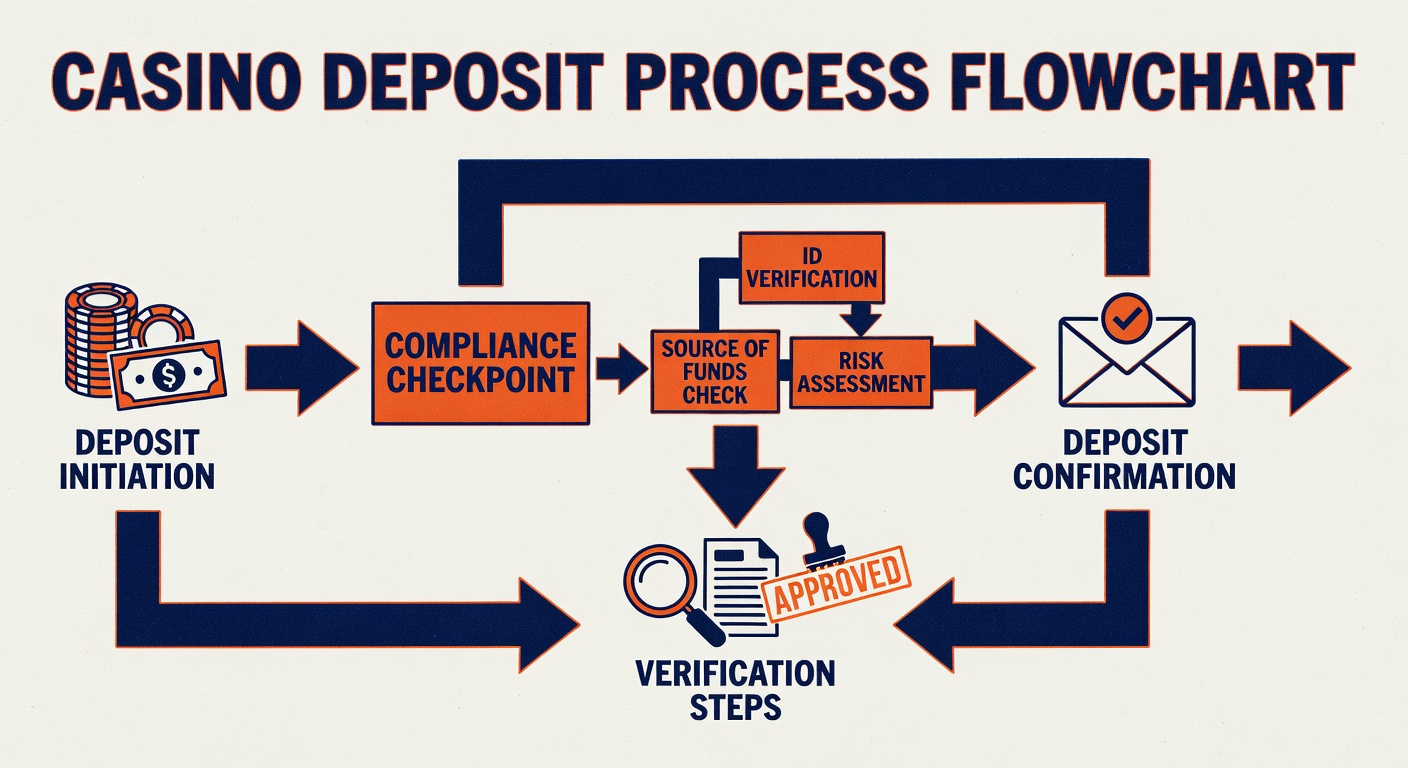
The deposit process at a regulated online casino is structured around five checkpoints. Each checkpoint serves a compliance function. Understanding these checkpoints clarifies why deposits sometimes fail or are delayed.
Checkpoint One: Identity Verification (KYC)
Before a deposit is accepted, the operator must verify your identity. The operator collects your name, date of birth, address, and national identification number. In regulated jurisdictions (UK, Malta, Curaçao), this is mandatory. The UKGC requires operators to obtain proof of identity (passport, driver's license) and proof of address (utility bill, bank statement) before accepting any deposits above EUR 2,500.
The verification process takes minutes to hours depending on whether your documents require manual review. Automated systems verify passports against government databases. Bank statements are reviewed manually for fraud signals.
Checkpoint Two: Source of Funds
After identity is verified, the operator must satisfy themselves that your deposit comes from a legitimate source. This is the AML (Anti-Money Laundering) compliance requirement.
The operator asks: where is this money coming from? If you are depositing EUR 50,000, the operator requires documentation showing the funds are yours. Tax returns, bank statements, payslips. The operator is legally required to establish a reasonable basis for believing your source of funds is legitimate.
This is not performed on every deposit. Regulatory guidance requires reasonable suspicion thresholds. A EUR 100 deposit from a newly created account requires minimal scrutiny. A EUR 50,000 deposit from a new account triggers automatic review.
Checkpoint Three: Payment Processing
Your deposit passes through a payment processor (Skrill, Neteller, or direct bank routing). The processor performs their own compliance screening. They verify that the payment method matches the verified player identity. A payment from a card in your name, to an account in your name, is approved. A payment from someone else's card presents flags that might delay processing.
The processor also screens against international sanction lists (OFAC, EU sanctions lists, etc.). If your name appears on a sanctions list, the payment is blocked and reported to authorities.
Checkpoint Four: Segregated Account Verification
The operator confirms that your deposit will be held in a segregated player account, not mixed with operational funds. In regulated jurisdictions, this is a legal requirement. The UKGC requires that operators maintain trust accounts holding only customer funds. If the operator goes bankrupt, players have first claim on segregated funds.
Checkpoint Five: Responsible Gambling Checks
The operator checks whether you have self-excluded (voluntarily banned yourself) at this operator or at other licensed casinos. In the UK, self-exclusion at one operator is meant to propagate across licensed operators through the GAMSTOP system. If you are self-excluded, your deposit is blocked and you receive information about support services.
The operator also checks your profile for problem gambling flags. If you have made multiple deposits in the past 24 hours, or if your deposits have increased dramatically, the system flags your account for review. This is a harm prevention mechanism, not a blocking mechanism. The operator reviews your account status before your next deposit is processed.
Timeline and Delays
A straightforward deposit (EUR 100 from a returning player, verified in previous sessions) processes in seconds.
A new player's EUR 100 deposit takes 24-48 hours because identity verification requires manual review.
A EUR 10,000 deposit from any player triggers source of funds review and takes 3-7 business days.
A EUR 50,000 deposit triggers all compliance layers and can take 2-4 weeks if the operator's compliance team requires extensive documentation.
Common Delays
Payment processing failures occur when the payment method doesn't match the verified identity. Your account is in your name, but your payment is from your partner's account. The processor blocks it. You must use a payment method in your verified name.
Document quality issues cause delays. A utility bill photo that is blurry or partially cut off requires manual review. Clear, full documents process faster.
Sanction list matches cause permanent blocks. If your name matches a sanctioned party (even partially), you cannot deposit. This is not the operator's discretion. This is regulatory requirement.
These processes exist because regulations require them. An operator that skips or shortcuts these steps faces licensing revocation, fines, and criminal prosecution. Compliance infrastructure is expensive, which is why unregulated operators are attractive to players wanting instant deposits. The trade is speed for safety.
End of the entry for Day 152