Primers · Daily read
How to Win Your First Poker Freeroll
A freeroll requires zero investment but full conviction. The expected value calculation changes when your buy-in is zero.
By Chris Vaughn, 4 min read
Day228
Entered under Primers. Also under Past years, Poker and Table maths.
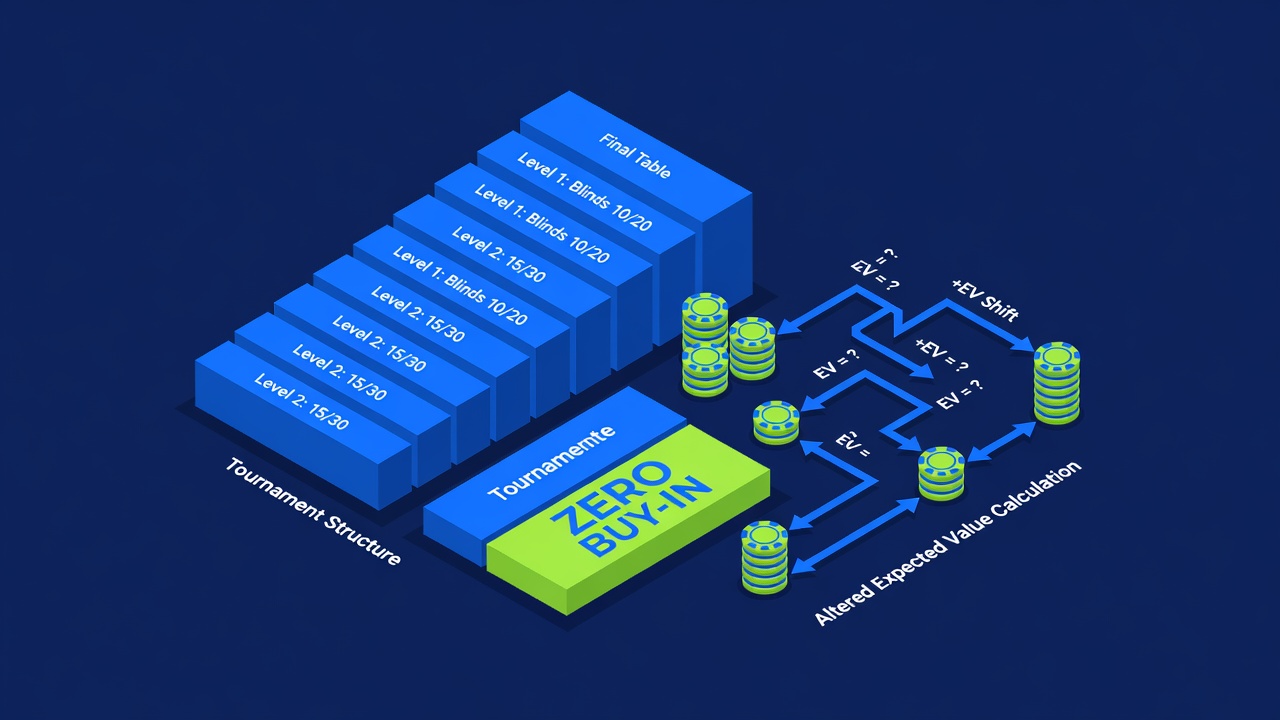
A freeroll is a poker tournament with no entry fee but a real prize pool. The player invests no money to enter, and if they win, they collect real cash. This creates a specific strategic environment that differs substantially from paid tournaments.
The expected value of a freeroll is positive from the entry perspective alone. You risk nothing. The probability of winning any money is non-zero. Therefore, the expected value is zero entry cost plus some fraction of the prize pool divided by the number of entrants. In mathematical terms, EV equals (your equity percentage times prize pool) minus (entry fee), which reduces to just (your equity percentage times prize pool) when the entry fee is zero.
This means any edge you have is pure profit. If you can identify positions where your win rate is 2% higher than average in a freeroll with 300 players, you have added value. The field in a freeroll is typically weak. Most players who play freerolls are beginners or people testing a new platform. This creates opportunity for anyone with fundamental knowledge.
The Strategic Framework
Freeroll strategy should emphasize exploiting weakness over balanced play. In a paid tournament, good players use Game Theory Optimal (GTO) strategies that are harder to exploit. In a freeroll, using GTO is leaving money on the table. The field is bad enough that straightforward, strong play crushes.
- Early tournament play: tight and aggressive, target weak players
- Mid-tournament: loosen up as bubble approaches, widen stealing ranges
- Late tournament: chip-dependent, push hard when shortstacked
- Bubble play: most freeroll fields are terrible here
The early stage of a freeroll, the first hour or two, should be spent making tight hand selections and punishing loose play from opponents. Many freeroll players open too many hands. When they do, they fold too often to aggression. You can win pots without showdown simply by representing strength consistently. This is not a profound insight, but it is effective against players who do not understand it.
Positional awareness is critical. Playing from the button and small blind is worth playing a wider range. Playing from early position should be tighter. The worst freeroll players do not adjust. They play the same hands regardless of position. Target them with position-based stealing.
The bubble in a freeroll is typically where your edge is largest. As the field shrinks and approaching players, most players become extremely tight. They are terrified of being eliminated just before reaching the money. This is fear-based play, and it is exploitable. You can steal blinds and antes with much weaker holdings. A shortstacked player who is afraid of busting plays almost no hands. An aggressive shortstacked player who does not fear elimination makes better decisions despite having fewer chips.
"The freeroll field is weak enough that playing correctly is more important than playing cleverly."
Risk management in a freeroll differs from paid tournaments. Since your downside is zero, you can take spots with lower equity if the payout structure justifies it. A coin-flip situation (50% equity) in a freeroll where the prize pool is top-heavy makes sense to take when you are shortstacked. The same spot in a paid tournament might not.
Hand reading in a freeroll is simpler because the opposition is less subtle. A loose player will bet the same way with premium hands and mediocre hands. You can exploit this through bluff-catching. A tight player's hand range is narrow and predictable. You can fold more easily.
The one mistake players make consistently in freerolls is playing too passively when they hit hands. A player who flops a set might check and give opponents a free card because they want to trap. But in a freeroll field, you are not trapping a good player. You are giving a weak player a chance to catch up for free. Value extraction is more important than deceptive play. Bet your hands. Make them pay.
Chip stack management becomes critical as the blinds increase. In a freeroll that lasts six hours, the blinds will get large. A stack that seems comfortable early becomes medium-stacked as the blinds escalate. Understanding your stack size relative to the blinds tells you when to push and when to fold. A stack that is 10 big blinds should be much more aggressive than a stack that is 20 big blinds.
The final table dynamics depend on payouts. If the top two spots are worth significantly more than spots 3-9, aggression at the final table increases. If all payouts are relatively equal, tight and cautious play dominates. Understand the payout structure before you arrive at the final table so you know which spots are worth taking risk for.
End of the entry for Day 228