Primers · Daily read
How to Handicap Tennis Matches on Different Court Surfaces
I spent three years counting cards before I switched to sports betting. The discipline was similar: track variables, identify edges, exploit them.
By Wendy Cole, 2 min read
Day278
Entered under Primers. Also under Sports bets and Table maths.
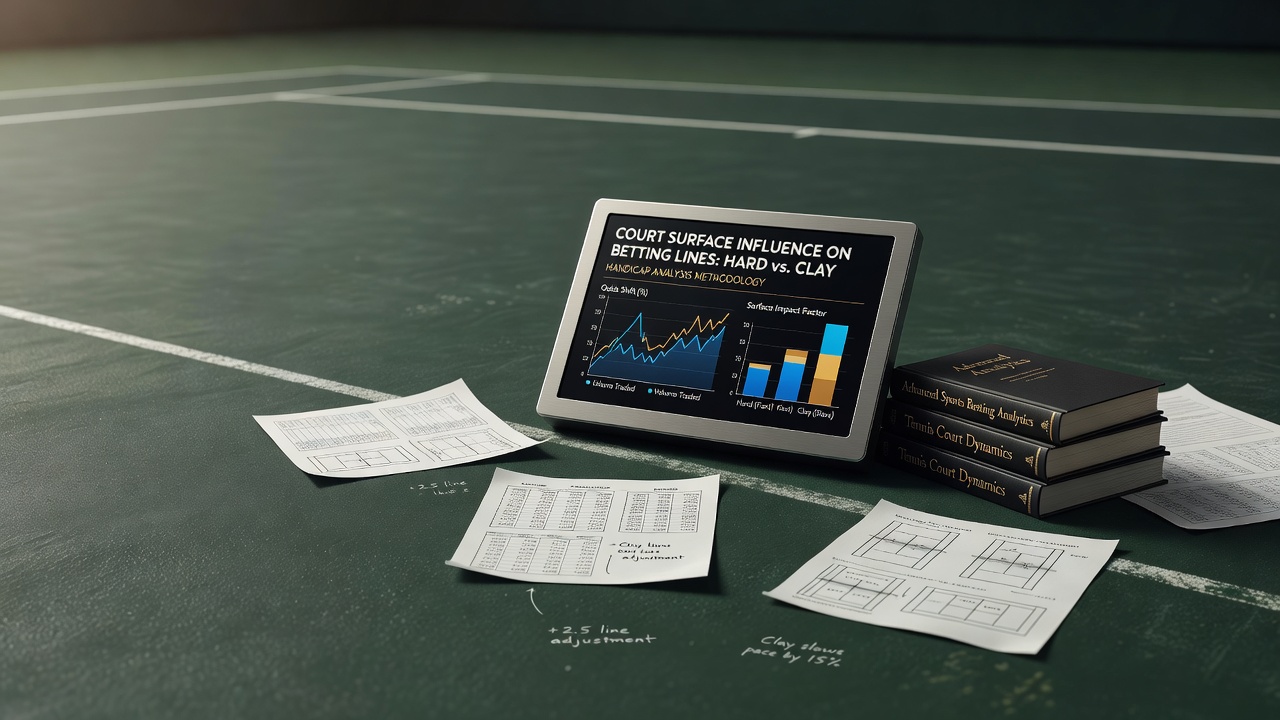
I spent three years counting cards before I switched to sports betting. The discipline was similar: track variables, identify edges, exploit them. Tennis taught me that the surface is the dominant variable that most bettors ignore.
A player who dominates on clay courts might disappear on grass. This is not randomness. The physics of the surface changes the entire game.
Hard courts are fast. The ball comes off the court quickly. There is minimal friction. A player with a big serve and flat strokes thrives. The returner has less time to react. Points are shorter. The game favors power.
Clay courts are slow. The ball grips the surface. There is massive friction. Topspin is exaggerated because it has more to grip. Points are longer. The game favors movement and consistency.
Grass courts are the fastest. The surface is slippery. The ball skids through. Serve-and-volley becomes viable. The returner has minimal time. The aggressive player wins.
Surface Specialization
Tennis creates specialists. A clay-court specialist has won fourteen French Opens because the surface plays to their strengths. That same player has won zero Wimbledons because grass does not suit their game.
The handicapping approach should focus on head-to-head records by surface. If a player is 25-2 on hard court but 2-5 on clay against an opponent, the surface difference is predictive. It is not random.
Movement efficiency changes by surface. On clay, lateral movement is easier. The player can slide. On hard courts, the player must stop and start, which is harder on the body. On grass, there is minimal lateral movement; the surface is too slippery to plant and push.
Service velocity is unaffected by surface, but the returner's ability to handle that velocity changes. A fast serve on grass is nearly unreturnable. A fast serve on clay is slightly returnable because the clay slows the ball's travel.
"Betting against a player on their worst surface is one of the few mathematical edges in tennis."
Recent preparation is crucial. A player who has played clay for two months is better prepared for clay than a player who has not touched it in eight months. Muscle memory in tennis is significant.
Condition at the event matters. A player might be in peak fitness for hard courts but out of condition for clay (which requires more lateral movement and more stamina for longer points).
The betting line often does not fully account for surface advantage. A player who is favored at -200 on hard court might be -300 on their specialty surface. The public does not bet enough on surface advantages, which means the line sometimes undervalues them.
The practical approach: Research surface-specific head-to-head records. Look for large discrepancies. A player who is 10-2 on hard court and 2-10 on clay against their opponent has a clear edge on hard court. The public betting might not reflect this edge, especially if the match is at a prestigious hard court event and the public is drawn to the player's name recognition rather than the surface dynamics.
End of the entry for Day 278