Poker · Daily read
Stud Poker Rules and Basic Strategy
Seven-card stud is poker's historical predecessor to Texas Hold'em. The rules are different, and the strategy requires thinking about hidden cards.
By Sam Ortega, 3 min read
Day237
Entered under Poker. Also under Table maths.
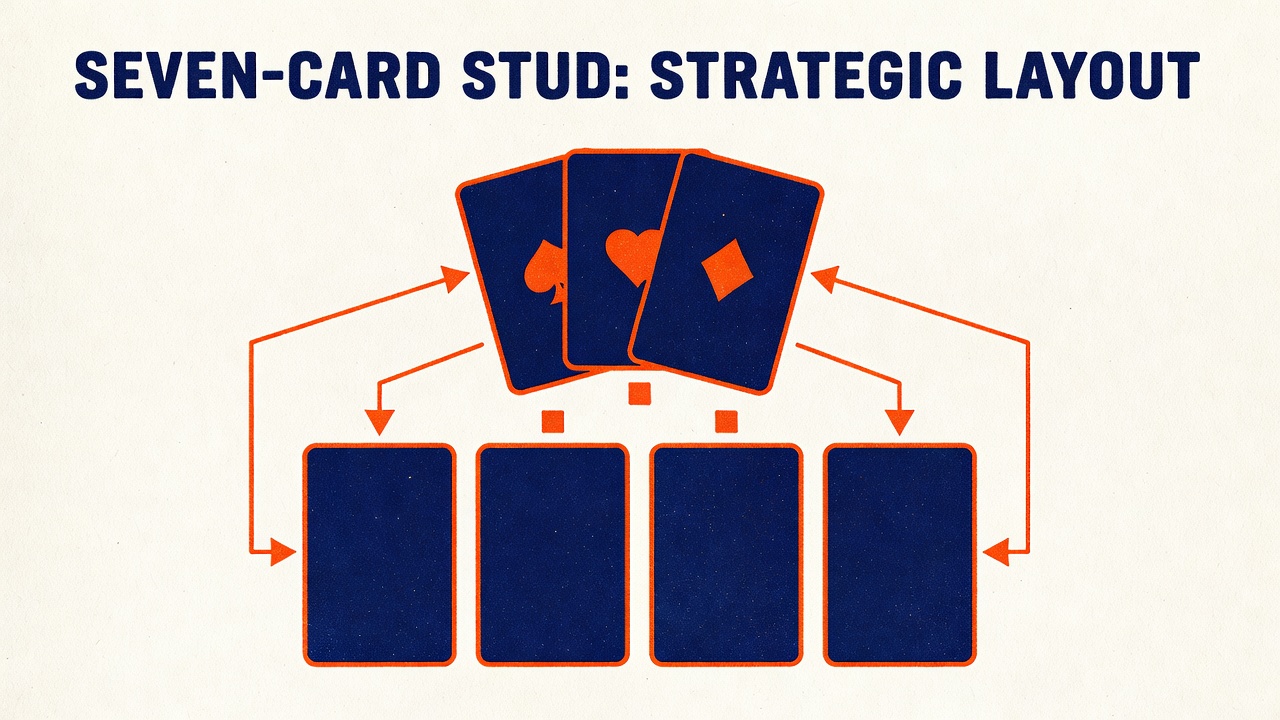
Seven-card stud is the oldest surviving variant of poker. Before Hold'em dominated, stud was the standard. The basic mechanics are deceptively simple and deeply complex simultaneously (which is basically poker in a nutshell).
In seven-card stud, each player starts with two cards down and one card up. The player with the lowest up card must "bring it in" (make the smallest opening bet). From there, betting proceeds normally. Then a fourth card is dealt face-up, followed by betting. A fifth, sixth, and seventh card follow the same pattern. After all seven cards are dealt, the best five-card hand wins.
The key difference from Hold'em: you never see most of your opponent's cards. In Hold'em, everyone sees the same five community cards. In stud, each player has their own private cards mixed with public cards. A player showing 3-3-5 with hidden hole card and hidden final card might have anything from a pair of threes to a full house. You have to infer their hand from the cards you see and their betting patterns.
The Strategy Framework
The foundational principle: hand strength relative to visible strength. If your opponent is showing 2-3-4 (straight draw), they are probably playing a straight or flush draw. But if they started with low cards and have not bet aggressively, they might be bluffing and just caught decent cards. Your hand evaluation depends on what you can see and what you can infer.
- Visible strength: the cards showing on the board
- Probable strength: inferred from betting patterns
- Actual strength: only revealed at showdown
The door card (the first open card) matters disproportionately. A player whose first card is a high card (like a King) is already showing strength. A player whose first card is a low card (like a two) is showing weakness. The bring-in player is often short-stacked and weak. This affects betting decisions early on.
The third street (after three cards are showing) is where many hands are won or lost. Players with weak visible cards and weak inferred hands often fold. Players with strong cards continue. The early fold decision is critical because the game gets more expensive as more cards come out.
Position matters less than in Hold'em because the betting order changes with each street based on visible cards. The player with the highest visible hand acts last. This changes from street to street, which makes positional advantage less stable.
"In stud, you are betting on incomplete information visible to everyone. The game is about accurately assessing your own hand relative to what you see and what you can infer."
The math of outs is similar to Hold'em but complicated by visibility. If you are on fourth street with a four-flush (four cards of the same suit), you have roughly nine outs. But if three of your suit are visible as an opponent's cards, you have only six outs. Counting cards your opponents show is critical.
The antes in stud affect strategy early. Antes are small forced bets everyone puts in before the hand. The antes create money in the pot that makes it worth fighting for weaker hands. Hold'em blinds are paid by two players. Stud antes are paid by everyone. This makes stealing the antes more profitable in stud.
The game is declining in popularity, which makes the few stud players still active disproportionately skilled. If you learn stud well, you might find favorable games because casual players often do not understand the variance and the strategy. But the game requires careful attention to exposed cards and betting patterns, which is work that many modern players are unwilling to do.
End of the entry for Day 237