Poker · Daily read
HUDs in Online Poker: What the Stats Actually Mean
Your HUD displays numbers that look like they are telling you everything. They are actually telling you almost nothing without context.
By Neil Harper, 3 min read
Day244
Entered under Poker. Also under Table maths.
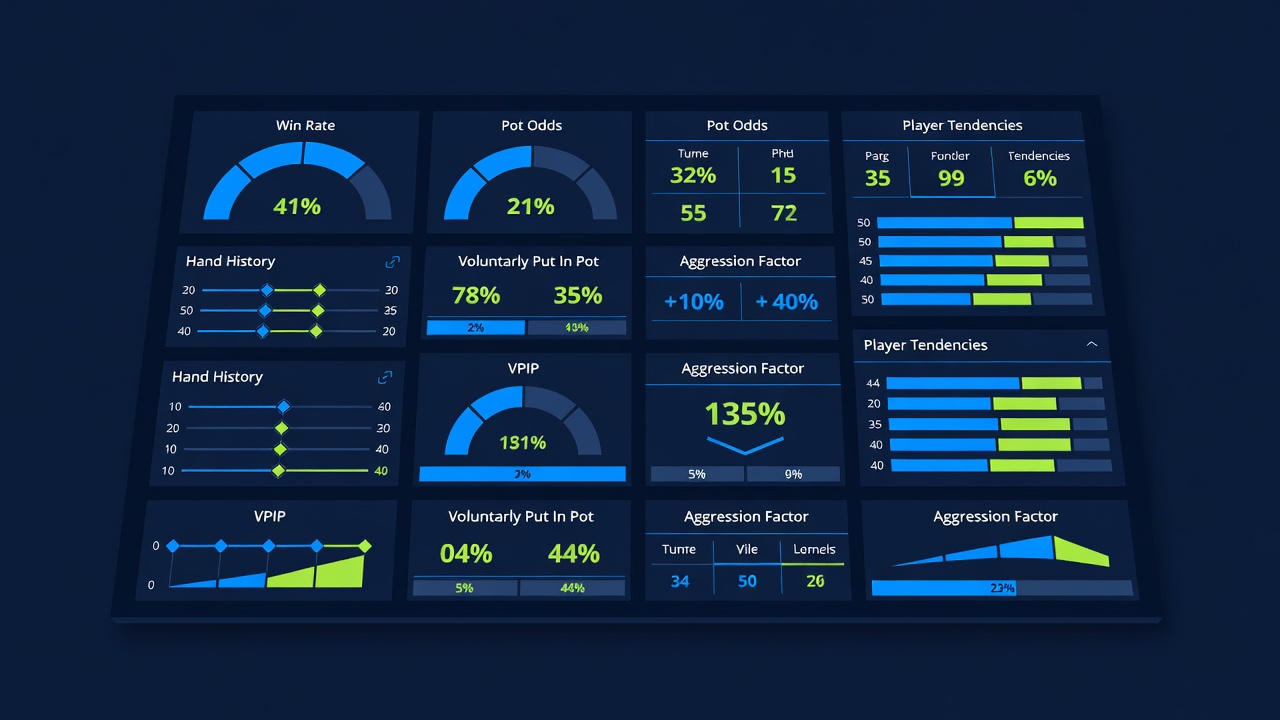
The HUD has become a crutch for players who confuse data with intelligence. I have watched skilled players make terrible decisions based on a single HUD stat, and I have watched terrible players beat skilled players despite the HUD screaming that it was impossible.
The problem is that a HUD shows aggregate statistics across a sample size that is almost certainly too small. A three-hundred-hand sample of a player is noise. The player's true tendencies require thousands of hands. Yet most online poker players adjust based on much smaller samples.
VPIP (Voluntarily Put In Pot) tells you what percentage of hands a player invests money in. But it does not tell you why. A thirty percent VPIP could mean a player is loose in position and tight out of position. Or it could mean they limp frequently. Or it could mean they play a narrow range but are in the big blind for half the sample. The context destroys the clarity of the number.
PFR (Pre-Flop Raise) is supposed to tell you how aggressive a player is pre-flop. But a high PFR in a small sample could just mean the player got lucky. They raised, they got hands, they won. In a thousand-hand sample, luck is minimized. In a hundred-hand sample, luck dominates.
The Sample Size Problem
Most online poker players have played between one hundred and five hundred hands against each other. This is an absurdly small sample for making reliable inferences.
The actual distribution of poker hand strength depends on mathematical principles that are not visible in HUD statistics. A player with a 25% VPIP could be playing any of thousands of different hand combinations. The HUD does not tell you which ones.
The aggression factor tries to measure how often a player bets or raises versus checks or calls. But aggression varies by position, by stack depth, by game state. A high aggression factor in a deep-stack cash game tells you something different than a high aggression factor in a tournament bubble.
The win rate statistic is the most useful but also the most meaningless in small samples. A player could have a sixty percent win rate over three hundred hands and a negative win rate over three thousand hands. The variance in poker is so large that short-term results are nearly random.
"The HUD is your first impression. Your continued observation is your final verdict. Most players invest in the HUD and skip the observation."
What the HUD is actually good for: identifying exploitable extremes. A player with a 50% VPIP (playing half their hands) is probably weak because they are playing too many hands. A player with a 10% VPIP (playing very few hands) is probably tight but skilled. These extremes are real and actionable.
The dangerous trap is assuming the HUD tells you anything about skill. A player with a high aggression factor might be aggressive and skilled or aggressive and lucky. The HUD does not distinguish.
The best use of a HUD is negative: identifying which tables have players who are breaking the mold. A high PFR, high AF player who is also losing money is probably a maniac you can exploit. A tight, passive player who is winning money is someone to avoid. But these evaluations require context that the HUD alone cannot provide.
The correlation between HUD statistics and actual skill is surprisingly low in small samples. Skilled players sometimes have unremarkable HUD stats because they adapt to their opponents. Unskilled players sometimes have impressive HUD stats because they got lucky in the hands they played.
The practical approach is to record your own observations. When you see a player make a decision, notice it. Over time, you build a model of that player that is more accurate than any HUD stat. The HUD is a starting point. The observation is the actual information.
End of the entry for Day 244