Blackjack · Daily read
The MIT Blackjack Team: How Card Counters Beat the House
A group of MIT students developed and executed a card-counting system so effective that they won millions from casinos in the 1990s before being shut down.
By Wendy Cole, 3 min read
Day171
Entered under Blackjack. Also under Who's who and Table maths.
The gentleman was not a gentleman until he arrived at the table. At that point he became someone else entirely. I remember him from his second visit. Brown suit. Silver cufflinks. A billionaire from somewhere or other, the way these high-limit players present themselves.
He played blackjack. He played with precise discipline. He did not drink. He did not celebrate wins. He did not panic at losses. He played with the mathematics of someone who had solved the game and was now simply collecting the solution.
That was the MIT team aesthetic. They dressed well. They were polite. They did not have the desperate energy of gamblers. They had the focused energy of engineers executing a specification.
The story has been told before but not from inside the pit. I watched the surveillance footage after the fact, and what struck me was how mechanical the entire operation was. There was no edge case, no variation, no gambling. Simply the methodical application of a system.
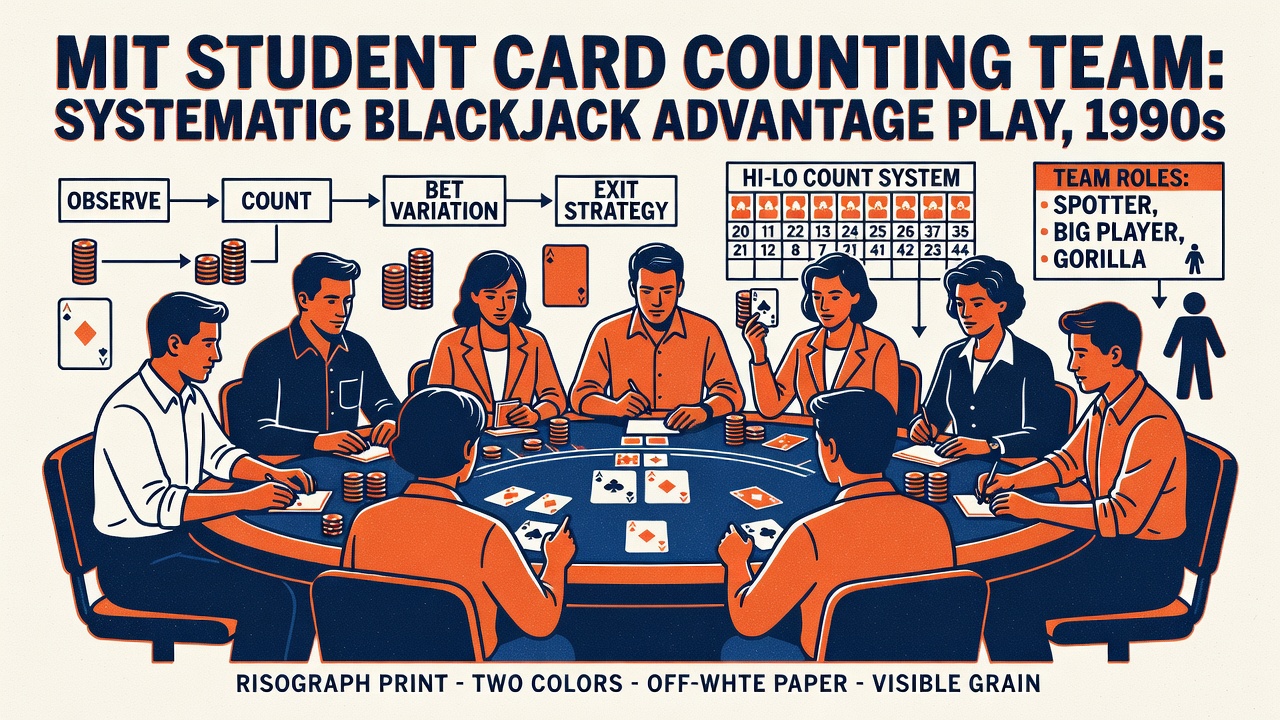
The team was assembled in the late 1980s from students at MIT. The core idea was simple: train card counters to identify when the remaining deck was rich in high cards (favorable for the player). When the deck was favorable, bet large. When unfavorable, bet small. The counter is not betting on every hand, only on the hands where the mathematics favored them.
The systems they used were sophisticated for the time. They employed spotters, who would sit at tables and count cards without wagering. When the count became favorable, they would signal a big better who would arrive, sit down, make large bets on a few hands, then leave. The spotter would remain at the table, ready to signal the next big better.
How the System Functioned
Card counting is not illegal. But casinos can ban counters. The MIT team was trying to make themselves invisible. They would have team members arrive at casinos from different parts of the country, unknown to each other. They would vary their behavior. They would lose on purpose sometimes to avoid suspicion.
The returns were extraordinary. By some estimates, they won 4 million dollars over a decade. No single hand was illegal. No single decision was even suspicious in isolation. But the pattern, when examined across time and across locations, revealed something impossible: consistent winning streaks at exactly the moments when the mathematics favored the player.
Casinos eventually identified them. Security cross-referenced surveillance tapes from different properties. Players who appeared at multiple casinos making suspiciously large bets when the deck became favorable. The pattern was unmistakable once you knew to look for it.
By the mid-1990s, the team was shut down. Casinos banned players they suspected of being MIT affiliates. The operations became impossible. The team dissolved.
What They Proved
The MIT blackjack team proved something that casinos had not fully accepted: a player with superior information and superior discipline could beat the house consistently. Not occasionally. Consistently. They did not need to cheat. They simply needed to understand the mathematics and execute without emotion.
After the MIT team, casinos changed their approach to blackjack. Some increased the number of decks in play, which weakens card counting. Some shortened the deck penetration, dealing fewer cards before reshuffling. Some simply hired more aggressive surveillance staff trained specifically to identify counting patterns.
But the underlying lesson was clear: the house edge in blackjack was thin enough that skillful players could overcome it. The response was to thicken the edge through rule changes. Casinos could not prevent card counting, but they could make it unprofitable.
The Mythology
The MIT team became mythologized. A book was written. A movie was made. People remember them as brilliant outsiders who beat the system. The reality was slightly different. They were people who understood probability and discipline better than most. They had access to capital to fund the operation. And they had the fortune to execute their plan before casinos fully adapted.
Today, card counting is technically possible but practically impossible in most casinos. The dealer plays more hands per hour, the deck penetration is shallower, the shuffle patterns are more randomized. A counter might gain an edge of one tenth of a percent if they were flawless. That is not enough to overcome the travel costs and the risk of being banned.
The MIT team's legacy is not that card counting works. It is that in any game with thin edges, discipline and information matter. The house does not want to admit this. But casinos adapted their rules specifically because it was true.
End of the entry for Day 171