Our tests · Daily read
French Roulette La Partage Rule: Why It's a Player's Best Friend
The La Partage rule cuts the house edge in half on even-money bets. If you play roulette and haven't encountered it, you're leaving money on the table.
By Sam Ortega, 3 min read
Day221
Entered under Our tests. Also under Roulette and Table maths.
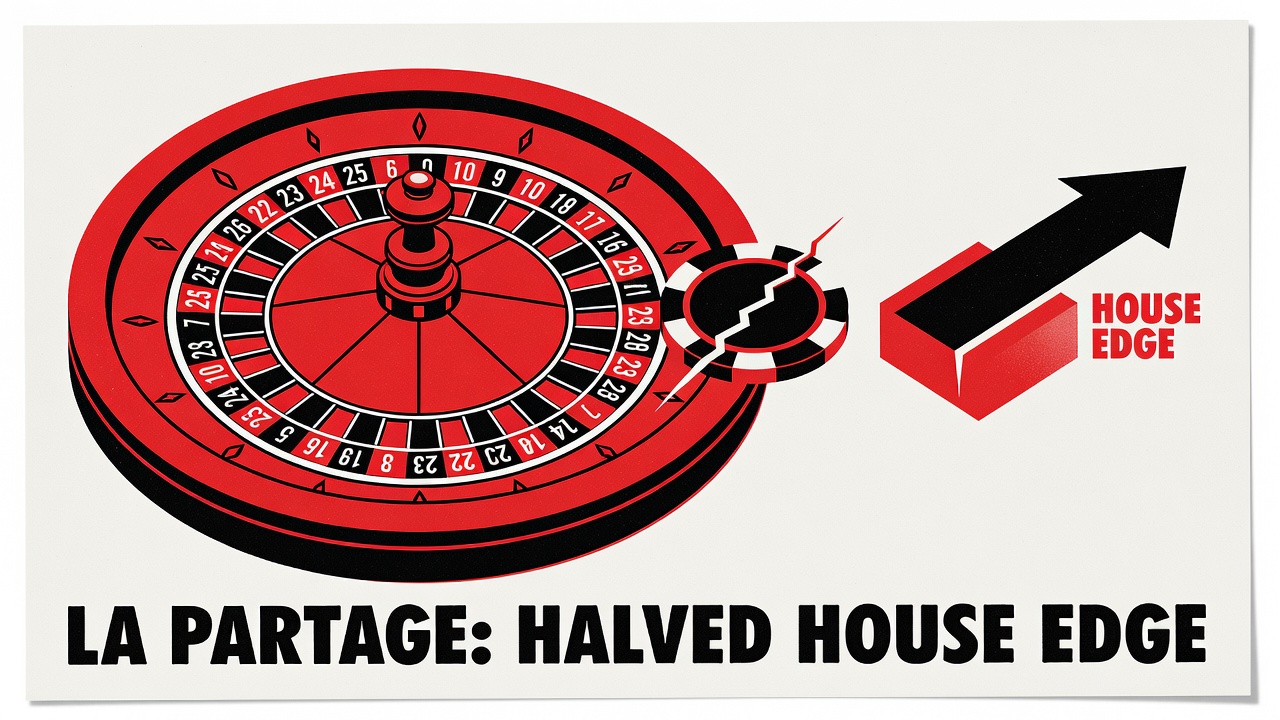
Most people think roulette is roulette. Spin the wheel, hope your number hits. But a quiet rule found in certain French casinos has been cutting the house edge in ways American roulette players never see.
The La Partage rule sits in the fine print of many European games. When the ball lands on zero, you don't lose your entire even-money bet. Instead, the casino takes half and returns the other half to you. It's a small rule with large implications.
The Math That Matters
In standard roulette, you face a house edge of 2.7% on everything. This is what the 37 numbers on a European wheel produce: one pocket (zero) in thirty-seven spaces. American roulette adds a double-zero, pushing that edge to 5.26%. La Partage changes the equation on even-money bets.
When you bet on red, black, odd, even, high, or low, La Partage applies. The zero comes up, and you keep half your stake. Over one thousand bets of $10 each, this matters. Your expected loss drops from $27 to about $13.50. For red or black specifically, the house edge falls from 2.7% to 1.35%. That is the difference between entertainment and self-harm.
- Straight bets: no La Partage protection
- Even-money bets: half your stake returned on zero
- Split bets: zero comes up, you lose the whole thing
- Insurance against the zero is built into the rule
The casinos that offer this rule know what they're doing. They're not running a charity. They still make money. But they're betting that players will stay longer, bet larger amounts, and feel better about the experience. Mostly, they're right.
Why This Rule Exists
Historical accident, mostly. French casinos developed this rule centuries ago. Nice, Monte Carlo, and other French Riviera houses made it standard. The rule stuck because it worked: better odds brought players in. Over time, the game's reputation improved even though the house still held an edge.
Online casinos now advertise La Partage as a feature. Evolution Gaming, one of the largest live-dealer platforms, offers tables with this rule. They call them French Roulette specifically to signal the difference. Players notice. They book sessions on French tables instead of European ones, even though the only real difference is this single rule.
You cannot negotiate La Partage. The casinos that offer it simply do, and they're usually European-licensed. If you're playing roulette online and the interface doesn't mention it by name, you're probably not getting it. Ask before you sit down. Read the game rules. This is the kind of information a thirty-second glance prevents an hour's worth of regret.
"The house always wins" is technically true, but it wins faster without La Partage.
The rule doesn't make you money. It makes you lose money slower. Some players feel cheated by this framing. They want to beat the game, not merely slow their losses. But roulette is not beatable. It's a negative-expectation game. Your only edge is choosing the game with the better odds.
If you play roulette at all, La Partage moves the needle in your direction. Not by much. Not enough to reverse the outcome over 10,000 spins. But enough that it becomes the rational choice when both tables are available. A player who always chooses La Partage over American roulette reduces their losses by about 50% on even-money plays.
That is, in the context of roulette, as close to a best friend as the game offers.
End of the entry for Day 221