Live dealers · Daily read
Dream Catcher: The Money Wheel That Started It All
Evolution Gaming's Dream Catcher became a cultural phenomenon in live casinos. The mechanism is simple. The payout structure reveals where the house profit actually lives.
By Sam Ortega, 3 min read
Day208
Entered under Live dealers.
How Dream Catcher Works
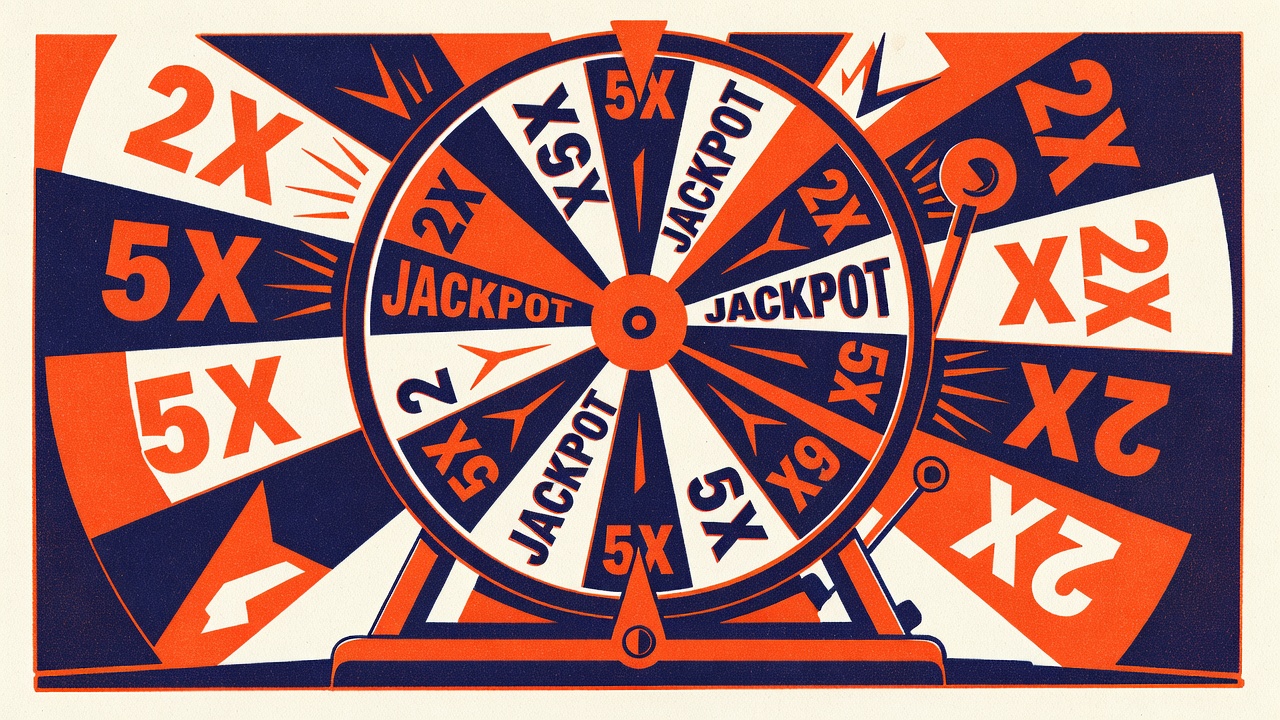
Dream Catcher is a live-dealer wheel game released by Evolution Gaming in 2017. The wheel has 54 segments, each labeled with a payout amount: 1, 2, 5, 10, 20, 40, 1X, 2X. The player bets money. A live dealer spins the wheel. The wheel lands on a segment. The player's bet is multiplied by the value on that segment or their bet is lost. The math is straightforward; the structure conceals something important.
The Payout Breakdown
The segments break down as follows: one 1, one 2, one 5, one 10, one 20, one 40, and fifty additional segments labeled 1X and 2X (multiplier segments that reset your winnings to their original bet amount, effectively losing all accumulated profit). The probability of hitting each non-multiplier segment is 1/54. The probability of hitting a multiplier segment (losing your win) is 50/54, approximately 92.6%.
This is where the math becomes important. A player bets GBP 10. They have approximately 1.85% chance of hitting the 40 multiplier and winning GBP 400. They have approximately 1.85% chance of hitting the 20 multiplier and winning GBP 200. They have a 92.6% chance of losing. The house edge on Dream Catcher is approximately 14-16% depending on the exact pay table the operator uses. This is significantly higher than table games like blackjack (0.5%) or roulette (2.7%).
Why This Design Exists
The 1X and 2X multiplier segments serve a psychological purpose. They don't reset the wheel; they appear as landed outcomes just like any other outcome. A player watches the wheel spin. It lands on 1X. They think: I almost hit 40. I was so close. The sense of near-miss is intense. This reinforces the variable-ratio reward schedule. Next spin, they're primed to play again. They're not thinking probabilistically; they're thinking emotionally about how close they were.
The wheel design is elegant specifically because it looks fair and looks exciting. The segments are large and visible. The spins are quick, approximately 5-10 seconds per round. The high-speed action and immediate feedback trigger dopamine responses. Neuroscience research on gambling shows that wheel-based games with fast feedback produce stronger engagement than slower games like slots (which have 3-5 second spin times).
The Revenue Model
Dream Catcher generates the highest per-bet revenue of any live-dealer game Evolution offers. The house edge of 14-16% means that a GBP 10 bet generates GBP 1.40-1.60 in expected house profit. A roulette table at 2.7% house edge generates GBP 0.27 in expected profit per GBP 10 bet. Dream Catcher generates 5-6 times the profit margin.
Operators love Dream Catcher because players love it. The game is not manipulative in the technical sense (the wheel outcomes are not predetermined; the game is fair). But the game is designed to exploit psychological biases. The near-miss effect, the fast feedback, the visual excitement, and the high payout frequency (on the lower multipliers) create an engagement curve that favors player re-engagement.
Why It Stuck
Dream Catcher's cultural phenomenon status in live casinos reflects a convergence: a fair game with elegant design, high house margins, and psychological hooks that work. Casinos adopted it immediately. Within three years of release, it appeared in every major live casino software ecosystem. Pragmatic Play and other providers released variants (like the "Mega Wheel" at Betfair). The model proved replicable and profitable.
What Dream Catcher demonstrates is that fairness and profitability are not opposites. A game can be mathematically fair (outcomes not manipulated) and structurally designed to extract more profit per bet than traditional games. The design lives in the payout structure, the speed of play, and the psychology of near-miss. The regulation of such games focuses on RTP disclosure, not on psychological design principles.
End of the entry for Day 208