Poker · Daily read
The Best Poker Books Every Serious Player Should Read
Poker is one of the only games where behavioral economics has direct financial application. The literature reflects this. The best poker books aren't about hand rankings or pot odds.
By Neil Harper, 3 min read
Day280
Entered under Poker. Also under Our tests and Table maths.
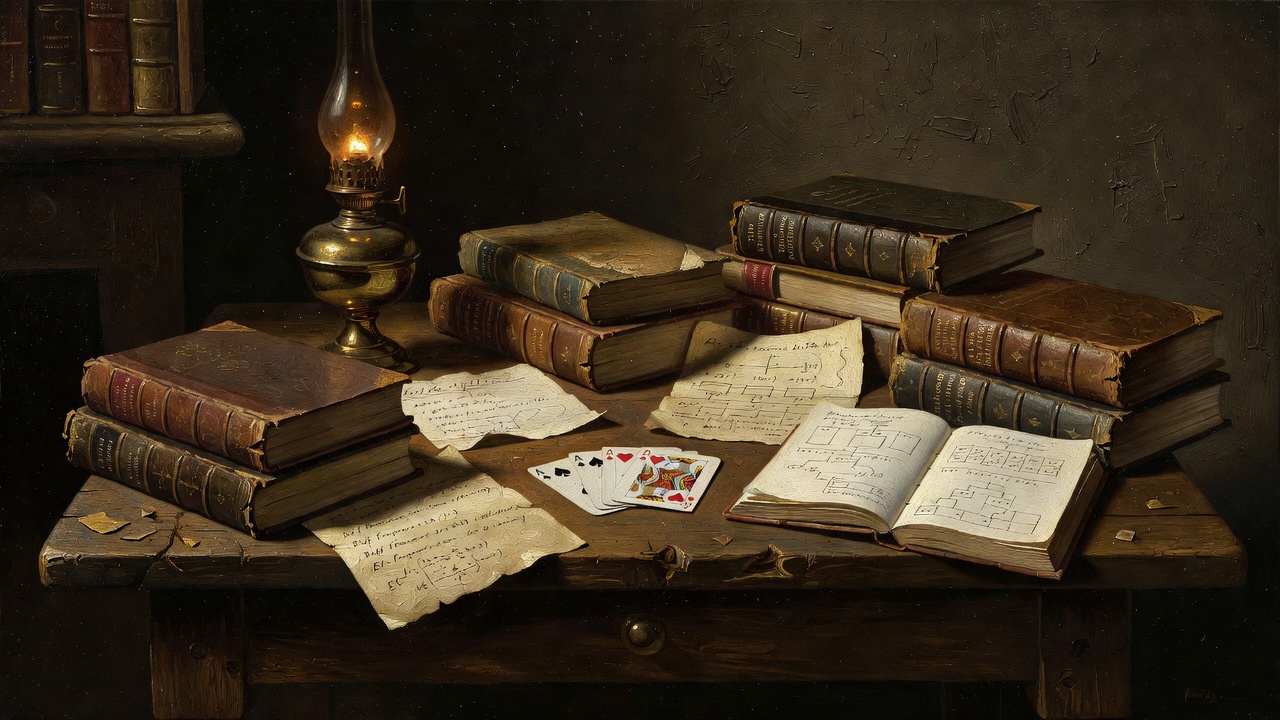
Poker is one of the only games where behavioral economics has direct financial application. The literature reflects this. The best poker books aren't about hand rankings or pot odds. They're about loss aversion, mental accounting, and the systematic ways human reasoning breaks under pressure.
Claim: You Win Poker by Reading Other Players' Minds
Reality: You win poker by understanding incentive structures. Doyle Brunson's "Super System" (1978) opened with a different premise: poker is game theory applied to cards. Brunson treated poker like von Neumann treated strategy. The player who understands the mathematics of position, pot odds, and value betting wins more than the player who reads the room. Reading is subordinate to math. Doyle's math held up. Players who internalized it made millions.
The misconception persists because Hollywood needs drama. Reading someone's face is a better scene than working through equity calculations. But the book that actually changed poker was "Harrington on Hold'em" (2004), which moved betting theory out of casino backrooms and into applied game theory. The book taught that poker is solved incrementally: position determines action frequency, action frequency determines range, range determines bet sizing. Emotion is removed from the equation by design.
Claim: The Best Players Are Instinctive Geniuses
Reality: The best players study prospect theory. Daniel Kahneman and Amos Tversky's work (formalized in their 1979 paper on prospect theory) explained why humans assign asymmetric value to gains and losses. People fear losing fifty dollars more than they enjoy winning fifty dollars. Poker exploits this. "The Mental Game of Poker" by Jared Tendler applies Kahneman directly to table play. Tendler interviewed dozens of six-figure players and found zero instinctive geniuses. He found players who deliberately studied their own biases and corrected for them.
The great poker players from 2005 onwards all studied the same material: probability, psychology, and the specific cognitive errors that separate winners from losers. There was no genius. There was competent study applied consistently over years.
Claim: Poker is About Having Courage to Make Big Calls
Reality: Poker is about mental accounting and loss-aversion correction. When you have a difficult decision, your brain uses mental accounting: it assigns a special status to money you've already lost (the "pot"). This is irrational. The sunk cost should not affect your decision. But it does. You fold hands you should call because the money you already put in the pot feels personal. "Thinking, Fast and Slow" (2011) is not a poker book, but Kahneman's explanation of why you make the mistakes you make in poker has no equal.
The best poker books teach you to recognize your own biases so you can override them at the table.
The courage narrative makes good stories. The accuracy narrative makes better players. A player who understands loss aversion makes better decisions than a player who summons courage.
Claim: Poker Books Can Teach You to Win
Reality: Poker books teach you the framework. You win through application. "Theory of Poker" by David Sklansky (1987) remains the foundational text because Sklansky explained poker as a language. Every decision has a vocabulary. Every decision has consequences that compound over thousands of hands. The book teaches you the language. You have to speak it at the table, every day, for years.
The books that work:
- Theory of Poker (Sklansky, 1987): Framework for thinking about decisions
- Harrington on Hold'em (Harrington, 2004): Applied game theory for tournaments
- The Mental Game of Poker (Tendler, 2014): Behavioral psychology applied to tilt and bankroll management
- Thinking, Fast and Slow (Kahneman, 2011): Why your brain fails, and how to notice
The common thread: all four treat poker as a discipline that requires defeating your own mind first and your opponents second. The reading is prerequisite. The winning is work.
End of the entry for Day 280