Record wins · Daily read
Antonio Esfandiari: The Magician Who Won the Big One for One Drop
Antonio Esfandiari won $18 million in the 2012 Big One for One Drop. The story is important because it reveals how poker tournaments market themselves and how variance works at the highest levels.
By Paula Nguyen, 2 min read
Day254
Entered under Record wins. Also under Who's who and Poker.
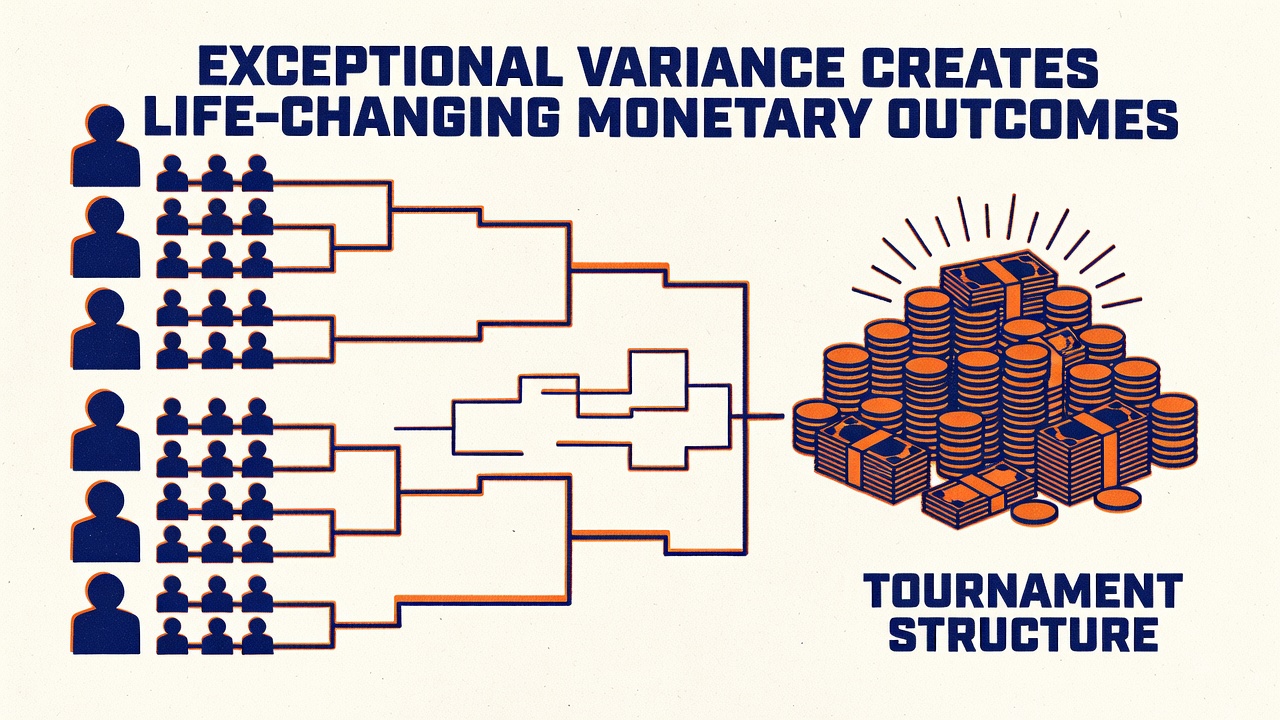
The 2012 Big One for One Drop was a charity poker tournament held at the WSOP. The buy-in was $1 million. A portion of the proceeds went to One Drop, a charity focused on water issues in developing countries. Only six players entered. Antonio Esfandiari won the tournament and $18 million.
The headline was irresistible: "Magician Wins $18 Million." Esfandiari had been a stage magician before becoming a professional poker player. The media loved the narrative. The underdog. The skill combination. The massive payout.
The reality is more complicated. Esfandiari was already an accomplished poker player when he played in this tournament. He was not an underdog. He was a legitimate professional up against other professionals. His previous wins had already established him as a serious player.
The $18 million figure is misleading in a specific way. The payout was for winning the tournament, but the structure was unusual. Because only six players entered, the money distribution was different from a normal tournament. Esfandiari's share of the prize pool was high because the total prize pool was enormous and there were few players to distribute it among. It was not like winning six normal tournaments. It was winning one unusual event where the variance was extreme.
The Tournament Mechanics
With only six entrants and a million-dollar buy-in, the total prize pool was $6 million. A significant portion went to One Drop. The remaining prize pool was distributed to winners. The tournament structure was deep and long, playing over multiple days. The variance was substantial because the effective stack sizes were enormous relative to the blinds.
Esfandiari beat players including Vanessa Selbst and Phil Ivey. These are skilled professionals. Beating them would be impressive in any format. But the format was one where luck plays a larger role than in a standard tournament because the stacks are so deep.
"The Big One for One Drop produced a story more compelling than poker. Esfandiari won partly by skill and partly by fortune."
The marketing around the event emphasized the charity aspect and the novelty of the million-dollar buy-in. The tournament was designed to be newsworthy. It succeeded. But the newsiness obscured the fact that the payout was unusual and the variance was extreme.
Esfandiari's career after the win shows that the victory did not establish him as permanently elite. He has had good results and bad results. The $18 million was a singular event, not evidence of persistent edge over top competition.
The most important takeaway is how poker tournaments market themselves through spectacle. A six-player, million-dollar-buy-in event is spectacle. The proceeds to charity make it respectable. The massive payout makes it newsworthy. Combine these and you get media coverage that treats the event as something important and Esfandiari as something exceptional.
He is a good player. The win was legitimate. But the interpretation that the win proves he is a world-class elite player is not necessarily supported by that single result. Poker has too much variance for one tournament to prove much.
End of the entry for Day 254